

Oh Carrie White.
With Halloween just around the corner and my excitement for Mike Flanagan's adaptation premiering on October 7th, there's a cultural resurgence of Carrie by Stephen King. The 1976 film is directed by Brian DePalma with Sissy Spacek portraying a deeply troubled teenage girl who is bullied relentlessly by her peers and abused by her mother at home. 50 years later (along with a couple of questionable adaptations), dePalma's film still remains a staple in the horror tragedy genre, but what does that mean for the legacy of Carrie White?
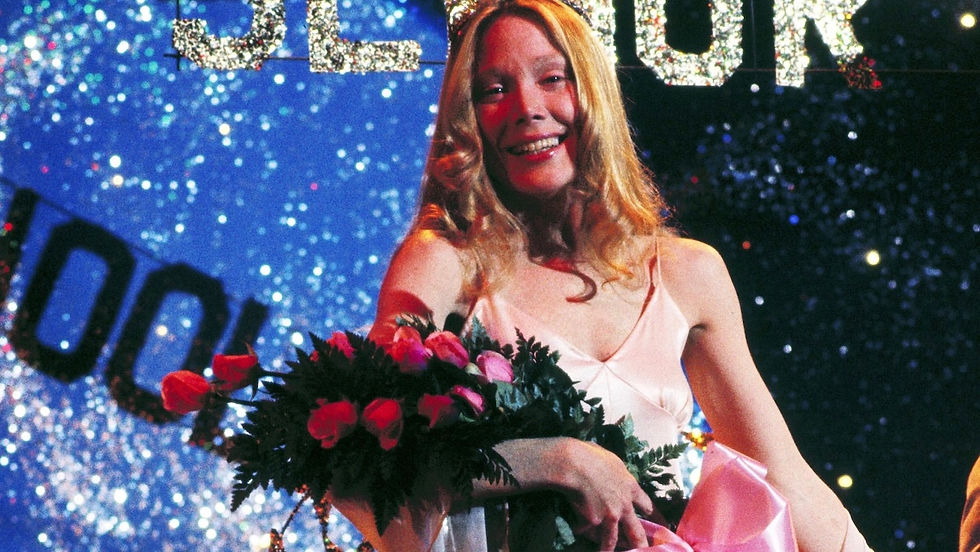
Carrie White is the daughter of a Christian conservative mother who abuses Carrie her whole life under the guise of protecting her from turning into a
"sinner" like rest of her peers. This brainwashing and infantilization turns her into not only an outcast, but a target of bullying from neighbors, teachers and classmates. When Carrie attends prom one of the most monumental moments of what she perceives to be a teenage girl's life, it gets ruined with pig's blood being poured on her by her vengeful classmate, Chris Hargensen. In a fit of rage, Carrie kills everyone at prom using her telekinetic powers and then later goes on to kill her mother as well.
Despite the story being set up for Carrie to finally break and kill everyone with her newfound supernatural abilities, I found the lack of over emphasis on the paranormal elements to be the most interesting. Stephen King and DePalma make sure to depict this story showing what the real horrors are, the psychological tolls of high school bullying and childhood abuse. Seeing a 16-year-old girl be tormented by her whole town for none other than the fact that she was socially inept is painful to watch and invokes a feeling of not only guilt but revaluation towards the type of behavior we allow in teenagers for the sake of
"fitting in."

This depiction doesn’t happen through Carrie herself, in fact, I don’t think we know anything about her at all. We only know her through the perspective of those that despise her and treat her poorly which makes her character even more unsettling. King himself admits in his memoir On Writing that he didn’t really care for her at all. That he had written a loser and Carrie’s problems didn’t move him emotionally. One of the biggest criticisms that I have against the adaptations is the inaccurate portrayal of Carrie. In the original story, she’s described as being bigger in size, and grotesque with greasy hair in the eyes of her peers. I was one of many who were a bit disappointed with Mike Flanagan’s casting, but it serves as a good reflection of the current cultural zeitgeist regarding body politics and our views on fatness and "unattractive" people in general.
I found that the true tragedy of Carrie lies in how her bullying was used for social mobility in high school which ultimately made her suffering useless in the end. As for her home life, she was doomed from the start with a religiously fanatical mother who resented her from birth and believed Carrie was sent as punishment from God for her sins. I don’t think she was the most morally driven person and what she did in the end was undoubtedly wrong, but did her classmates and teachers deserve it? Who’s to say who gets to live or die. I don’t know how I feel about King’s repulsion towards Carrie as a character, but the message was delivered in the end and that's that we should all simply be more kind to each other.
Happy October :)



Comments