

We only have now
I feel like every time I go to watch a movie in theaters, I come out thinking that it's the movie of the year, and then I go see another movie and have the same thought. However, this time I’m sure that this movie is my favorite of the year, and I’m not changing my mind.
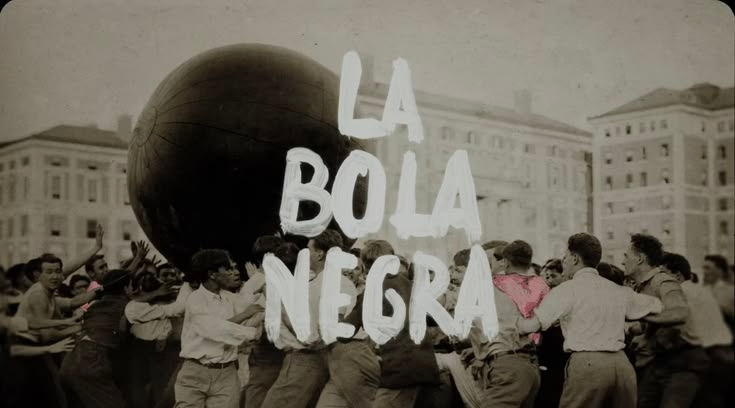
La Bola Negra is a Spanish drama and historical fiction film directed by Javier Calvo and Javier Ambrossi. The film takes place in Spain, spanning from 1932 to the Civil War in 1937, and to 2017; it follows three gay men, Carlos, Sebastián, and Alberto. This movie explores desire, legacy, and the historical persecution of the LGBT+ community. The film takes inspiration from an unfinished work by Federico García Lorca, La Bola Negra.

Carlos
Carlos is a young man from a wealthy family who applies for membership at an elite social club and is rejected by a black ball ballot (white ball is yes, black ball is no) because of rumors of his homosexuality. One of my favorite parts of the film is when Carlos goes to the club after being rejected and dances to seguiriya (a form of flamenco). Everything about this scene was just so mesmerizing. The amazing vocals, the instrumental you can feel in your heart. The way Carlos goes from drunkenly swaying to vibing to the music, with a cigarette hanging from his mouth and clouds occasionally puffing out. The crowd he dances with that surrounds him, adding to the suffocating vibe Carlos must be feeling, with his sexuality being the town's “open secret.” The fact that during this dance he takes a white pool ball, kisses it, and gives it away. It was just so beautiful, and I just love a good musical/dance scene.
Carlos’s ending had the most impact on me. He goes back to the club to get them to revote. The committee asks him if he is gay, and he denies it. As soon as he denies it, a mob storms in and the building is destroyed. Carlos denies who he is; it is a choice that he can’t go back from. He wakes up on a snowy mountain, signifying the journey of death. On this journey of death, he realizes that he wasted his life by hiding who he is. He begs to go back to the living world, but death is something you can’t go back from. As he is having his final moments, he asks, “What if they don't find me?” The character of Carlos is based on the lost play by Lorca. Many of the characters in this film are gay, and most of them keep it hidden. While Carlos’s final question could have many interpretations, I believe that this question is meant to bring awareness to the many queer people who hid themselves due to harsh prejudice against the LGBT+ community. “What if they don’t find me?” is a question based on the fear of no one truly knowing who you are. Keeping your sexuality locked up for your safety but risking the chance that no one will know your true self. And isn’t hiding your true self essentially erasing yourself? I also believe that Carlos’s final question is a reflection of the lost pages of Lorca’s La bola negra. It is rumored that the lost pages are buried in a soldier’s chest. As long as the play stays lost and unfinished, we will never know the true ending. In his final question, Carlos asks if his story will be found and if his story will be told and finished.
“Siento que nunca he vivido porque las horas no me han pertenecido”
“I feel like I have never lived because the hours have not belonged to me."
-Carlos, La Bola Negra

Sebastián
Sebastián’s story starts with his village being attacked by Italian aircraft. He manages to escape but is forced to join the nationalists to survive. He is then tasked with guarding Rafael Rodriguez Rapun and getting information from him. Sebastián discovers his homosexual desire as he bonds closer to Rafael. The scene in Sebastián’s story that I think is most impactful is when he and Rafael are having their final moments together. Even though I knew that Rafael was being taken to be executed, I kept hoping that something would happen to keep Rafael alive. That Sebastián and Rafael could have the luxury of time to be able to fall in love. But of course, because it’s a war, nothing like that happens, and Sebastián ends up being forced to kill Rafael. They spend their final moments silently and secretly comforting each other. Rafael tells Sebastián that he was scared but that he wasn’t anymore because of him, and he then passes on the important task of protecting Lorca’s legacy so that one day in the future, his story will be told to those who need to hear it.
Sebastián’s story shows us the sad Consequence of living your life in secret. From the moment he realized that he was gay, he kept his true self locked up. He kept this huge piece of who he is hidden his whole life. It was so well hidden that his daughter and grandson didn’t find out he was gay until he died. It was so well hidden that his daughter told her gay son that his grandpa would have hated him because he was part of the fascist group during the war. Even when homosexuality slowly started being more accepted, Sebastián didn’t dare to let it be known that he was gay. Up until his death, people thought he was living with his cousin in the countryside, when he was actually living with his partner. Sebastián’s story tells us that even when the threat is gone, fear will still linger. While I’m glad that I live in a place where the LGBT+ community is accepted, I can’t help but wonder how many of the older generation still stay hidden because of the whispers of threats from the past that stay in their mind.

Alberto
Alberto is a historian and a playwright. He is researching queer dissidence in music when he is contacted by his grandfather’s lawyer, who informs him that his grandfather has passed and left an inheritance for Alberto, but he has to go to Cantabria to collect it. His mother urges him not to go, but he does; it’s here when we find out that Alberto’s grandfather is Sebastián.
While I think Alberto’s storyline is the least impactful and the least entertaining, I still think it’s quite important. It showed us how Sebastián’s consequences trickled down to his family. Before we find out that Sebastián is the grandfather, we are told that this mystery's estranged person was a horrible father who left his daughter. We are able to see how that abandonment affected the relationship between Alberto and his mother. His mother tells him that Sebastián left her to grow up on her own, and Alberto states that she left him to grow up on his own as well. Sebastián hiding his true self led to him not being able to tell his family the truth, which then led to him being a horrible parent and only knowing his grandson from afar. Would this family have turned out differently if Sebastián opened up to them?
La Bola Negra is a film about the hidden history of queer people, legacy, and the cost of political oppression. It’s a film that urges us to be who we are, to not repeat the mistakes of the older generations. We only have now, so make the most of it; don’t be at the end of your life, feeling like your life wasn’t your own because you weren’t yourself. Out of all of the movies that have come out this year, this one is definitely the one that made the most emotional impact. I also think that watching a movie in my native language, Spanish, made the impact much stronger for me. It’s a shame I haven’t seen many Spanish movies, but that’s going to change. I really wanted to watch this movie again, but unfortunately my local AMC is not showing it anymore, and I’m not sure if other theaters are. But if you want to see this movie, it’s coming out on Netflix in early December.


Comments