

You Are Haunted By Everything You See
From Nathan Fielder and Lance Oppenheim, fresh off the Primetime hype comes a fascinating and terrifying portrait of Elizabeth Holmes.
This will be a Tell-All, many spoilers below
be aware
"The German word unheimlich is obviously the opposite of heimlich, heimisch, meaning “familiar,” “native,” “belonging to the home”; and we are tempted to conclude that what is “uncanny” is frightening precisely because it is not known and familiar."
-Freud, The Uncanny
The specters and hauntings of our modern times are taking new forms. A dead man's hacked Instagram page, a rockstar who sees the same man out of the corner of his eye for months as he travels across the country on business, an ai deepfake of your neighbor, a girl who knows the names of all your high school classmates but you cannot place in the yearbook; we have created ghosts through our technology, and hauntings through our culture. The uncanny is obvious with AI deepfakes, the way a spirit in the shape of your ex-lover turning up on your doorstep acting off comes to mind. That is not your girlfriend, it only half moves like her, and sometimes its shape falls a bit, and you see what is really underneath. The hauntings of our culture, however, are a bit more complicated; to illustrate let me tell you a story from my family.
A long time ago, an ancestor of mine had an affair with a servant girl and she fell pregnant and bore a son. Now this ancestor had no heir, and this servant girl had no family, which are both big deals in long ago-Rajasthan. The girl told my ancestor he should take her son and ensure her care, he refused, solving his heir problem by adopting a child. The servant girl cursed him, and when she died, how and when I do not know, she began haunting this ancestor's family home. Now, my family did not have an heir for the following four generations, all sons were adopted from elsewhere. The ancestor of the original sin died and the girl's ghost was extracted from the house, there is a gap in my knowledge until my mother's generation. The cousin of my mother, who I have never met, is said to harbor the soul of this ancestor. She speaks as him, laughs as him, knows as he knew, and the most fascinating, her small body, stick-like my grandmother recalled, carries the weight of a proud man of old. My family considers this a blessing, they say he is with her always, watching, but the first time I heard this story I was struck with a sick sense of fear and horror.
The story I just told is what can be considered a "real" haunting, an honest-to-god ghost. Where they find love I find a curse, to always be watched by this ancestor is terrifying to me, to have your every action seen and judged, not just by him but our entire line is sickening. I cannot in my heart find joy in this ghost being real, and thus I cannot believe it or my hands start to shake. My family has beginning history of delusions, the type caused by an often-inherited strain of mental illness. Here is where the story crashes into a reality, the ghost is real to them, the mental illness is also real. If I say my mother's cousin is possessed by a ghost is this a lie? That is the question Nathan Fielder is trying to answer in You Can See Everything.
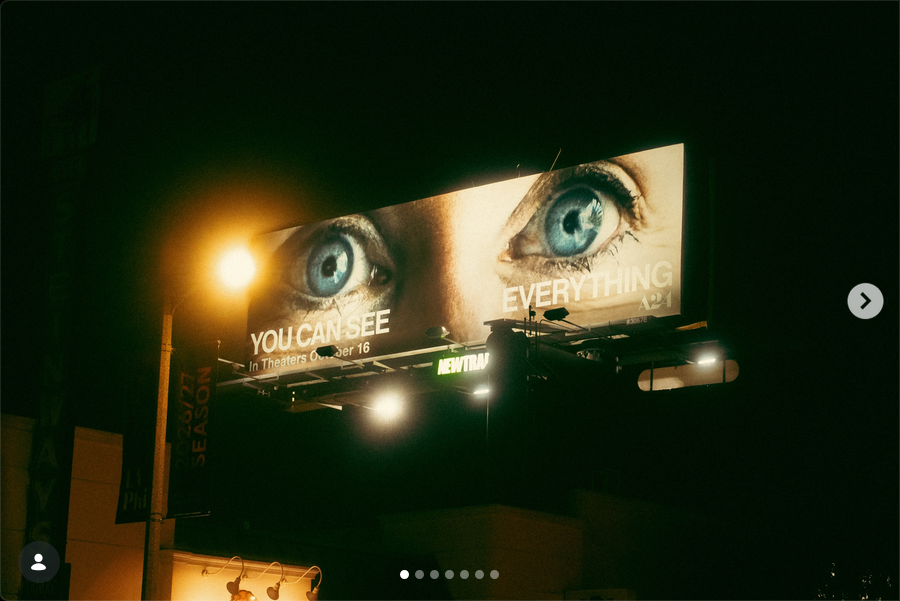
The documentary opens with Fielder frequenting the Holmes household with a camera crew during the day and crashing in a motel at nights. He doesn't quite know why he is here, invited by Elizabeth Holmes and her husband, Billy a month before she is set to serve 11 years in prison. Why invite a man famous for breaking down business scams and frauds to document your statements of guilt? Nathan asks Elizabeth once. She tells him she didn't know he was known for that. Holmes insists she is innocent, that she did not lie, that she never lies. This is paired with the imagery of her blue, unblinking eyes, blue as the depths of the ocean that crashes outside throughout the first act. The marketing of this film has centered on these eyes, the billboards (pictured at the top) evoke Baz Luhrmann's The Great Gatsby, the eyes of T. J. Eckleburg. Where Luhrmann's interpretation is often put on the Eyes as some Holy disapproval, God or the past looking at how we have falling into consumerist hedonism. Holmes' eyes are vast, is it fear, is it a challenge, is it shock, is it crazy, is it a cry for help? The only thing we can solidly discern is something is not normal. Eyes are normal objects, seen everyday, as Freud notes "the 'uncanny' is that class of the terrifying which leads back to something long known to us, once very familiar." But something within Elizabeth Holmes' gaze is terrifying and I cannot for the life of me define it.
Of course Freud is positioning the uncanny as primitive fear (which is more applicable to Primetime thematically) but Freud has also never experienced being shown an AI generated video of yourself by your mother who excitedly exclaims "you don't have to be a filmmaker AI can just do it for you." Around the halfway mark of the film, Billy and Elizabeth take Nathan to a camera studio, where they are going to take pictures of Holmes to reconstruct her digitally, so she can keep a physical presence in her children's lives. Now to me this sounds like some Silicon Valley other world BS but Holmes is hesitant, because she understands the power of an Image. Though she disassociates film from the still image (which is kinda interesting to me) Billy pushes her to take the photos, which will then be used by him to AI generate videos of her saying things while she is in prion. I cannot help but think back to specters. An AI generated image or video of a person is a haunting spirit, it is not you and you often have no control over it, a doppelganger or double. There is a lack of agency here, at the hands of her husband who control all aspects of her image as she is in prison. It's a horrible thing, the manipulation of Holmes by Billy, but it also makes her conflicting.
Amanda Seyfried played Elizabeth Holmes in the 2022 miniseries The Dropout which is hailed by Holmes as a gross exaggeration that only served to villainize her. Seyfried also serves as a perspective on Holmes during the second half of the film, partially out of her own curiosity, and partially to play her in Nathan's reenactments. I find this fascinating as a juxtaposition to Billy, Holmes' husband and business partner, who in turn supplements her absence with a giant obelisk-like screen with Holmes deepfaked onto it. Nathan has Amanda who has her own thoughts and feelings, Billy has his deepfake, that often skips and cuts like an old CD, both are distorted realities, both are uncanny. I personally was so fascinated by Seyfried presence, her guilt for how her portrayal effected Holmes but assertions that she did nothing wrong and the show was not a lie are things she speaks in the same breath. When she is acting as Holmes in reenactments, it's different than when we see Holmes herself on camera, Seyfried believes Holmes is guilty and lying, Holmes says she believes she is innocent and truthful. I believe memory is a monster.
Freud connects the uncanny to the repressed, things forgotten or suppressed that conjure the feeling of fear in the back of your mind when poked. I think this is true for Elizabeth Holmes, who, as said by her father, has been in relationships with horrible manipulative men since she was 19 years old. If you want to believe a large line of thinking from the first act, Holmes is in the situation because of a mistake of words, a miscommunication, something she said offhand that became too important. Throughout the film, there are instances where Nathan will ask her a question and she will respond with "I don't know" or "I don't remember that" this also occurs with Billy. The question that comes after is can these missing memories be lies?
Holmes was out of public eye from the collapse of Theranos in 2018 up until roughly the filming of this documentary. She has been at odds with the public perception of herself, trying to assert her story while the media seems to run circles around her. Remember the story of my ancestor, who is haunting my mother's cousin? Elizabeth Holmes is surrounded both by specters and hauntings, the specters being the individuals and technology, the hauntings being the public. Now I'm not saying a haunting is a good or bad thing, it can be A Christmas Carol or Uncle Boonmee Who Can Recall His Past Lives. My focus is on how the need to live in someone's skin is bad. Circling back to Seyfried, who did kinda 'live' in Holmes' skin and coupling her with Nathan Fielder, who lived with her and her family for two weeks, we see two sides of the same coin. Amanda has an almost parasocial relationship with Holmes, Nathan seems to feel like a translator for her in a space where she is presented as unknowable by Billy. They both feel something complex, Amanda thinks she understands her more than she does, this is evident in how her performances are undercut with deception, which is how film acting often works she does a wonderful job, it just isn't reality. Nathan's feeling are kinda difficult, he is trying to reach her, he writes to Holmes while she is in prison and one of the first things he tells her is he recently went through a break up. When he lived in their house for a time, they were always very physically close, and Elizabeth seems to speak candidly and openly. She tells him it took her a long time to be able to cry in front of people, before letting a tear fall down her face. In the film's ending scene, Amanda accuses Nathan from cutting things from the film to protect Elizabeth because he cares for her. Both of these relationships create distortions of the real Elizabeth Holmes, who I do not think we truly see in this film, the nature of the camera inspires people to act, and the heavy weight of the voyeuristic framing encourage that. I think Elizabeth Holmes is haunted by the public, by the eye of the people the way the voyeuristic nature of film haunts all cinema. Why is this shot framed like that? The director's sick desire? or does it mean something, in cinema anything can be intentional, can mean something. This is a haunting, you cannot escape that weight, not unlike my mother's cousin and our ancestor. Holmes cannot escape perception thus by bringing in Nathan is trying to regain control, she claims she only knows him from a clip from his show Nathan for You so why call him up? Why invite him to live with you for a month? Why let him bring a whole camera crew into your home to grill you during your last days as a free woman?
Holmes wants to exorcise her ghosts, the public perception of her, but forgets that ghosts are always hunger. The public hungers for information, not because they care about pardoning her, but because they want to know her. Some cultures trade stories to their ghosts to put them at ease, news of the living they have left behind. In a way we are all dead droning on in some limbo waiting for a story that will bring us a fleeting sense of life. The public is my ancestor clinging to Holmes for her stories, is it so horrible for him to want to be tethered to life? No one wants to die, "...it is no matter for surprise that the primitive fear of the dead is still so strong within us and always ready to come to the surface at any opportunity. Most likely our fear still contains the old belief that the deceased becomes the enemy of his survivor and wants to carry him off to share his new life with him." is what Freud has to say about the origins of the uncanny, we all know we will die yet we still fear it, something both familiar and unknown. We are the dead and Holmes is the living, she so desperately wants to stay with the living that she bends to us, the dead to feed our constant hunger. To me, the haunting the public does is a form of surveillance, due to the casual camera everyone carries, the voyeuristic culture of watching is shaded, we do not watch with our eyes, we watch with the lens, then our eyes, a proxy for our pleasure. The film's focus on Holmes' eyes thus evokes the uncanny, something long known to us, by breaking the conventions of eye contact. We trade off; we the public derive pleasure from watching her, she gets back by unnerving us with her eyes, it doesn't work, in turn driving more people towards her. I do not know her intentions and they may not fall in with this at all but the broad strokes I feel ring at least a little true.
The title of the film You Can See Everything is the promise of a cure for the feeling of uncanny that is evoked by Holmes, who's obscene amounts of eye contact made by hand's itch and skin feel wrong, like I'd been caught in a lie. But the promise is broken, Fielder does not solve Holmes, break the case that she was lying and knows she's guilty. He only delivers what he was shown, a woman who says she isn't guilty but presents moments of falsehoods, her husband who is an absolute freak that controls every aspect of her public persona, an actor who is guilty about her role in this woman's life yet certain she has a deeper understanding of her, and himself a tangle of uncertainty. Reality is somewhere between all of their truths, you can see everything that you are shown, but the truth might not be one of them. Holmes is haunted by us, and in turn haunts us. She is plagued by specters of her husband's design, and an actor trying to wear her skin. She haunts Nathan with her uncanny way of holding his eyes and not blinking, something her husband says is her way of flirting. She is haunting the film with her lack of presence, she is haunted, haunting, and specter. She can see everything, know everything,


Comments