

The Music of Nashville (1975)
Hey guys! This blog marks my fiftieth for the UIC Radio, so I thought that I’d switch it up a little bit. For the first time, I’m going to write about a movie– specifically, my favorite movie of all time, Robert Altman’s Nashville (1975). The plot follows a loosely connected bunch of musicians, political campaigners, and various other troubled people as they navigate overlapping personal challenges over the course of a few long days in Nashville, Tennessee.

Ever since Nashville was released, there’s been a debate about whether or not it should be considered a musical. On one hand, the movie is filled with musical performances, with music taking up about a third of its total runtime. The characters do not break spontaneously into song as they typically would in a musical, but instead are musicians whose presence in the studio and on stage features heavily in their lives. Unlike most musicals, every song was recorded live on set with the actors singing and playing instruments themselves, so that the music sounds as it would if you were in the room with them. But, like a musical, Nashville uses these songs to help tell its story, albeit indirectly.

Throughout Nashville, the idea of performance is used to measure the distance between the way its characters portray themselves and their actual lives. Politically, it parallels this by drawing a dichotomy between the fictional America and the real one. The movie opens on country star Haven Hamilton (played by Henry Gibson) in the studio, recording a patriotic anthem to celebrate the nation’s bicentennial. In the chorus, he belts the phrase, we must be doing something right/ to last two hundred years! The rest of the movie, though, dives deep into the feeling of dissatisfaction that many Americans felt in the post-Vietnam war era, as well as exploring the country’s enduring social issues. Later on, Haven Hamilton is exposed directly to some of these problems, but maintains his spotless, optimistic country-star image.
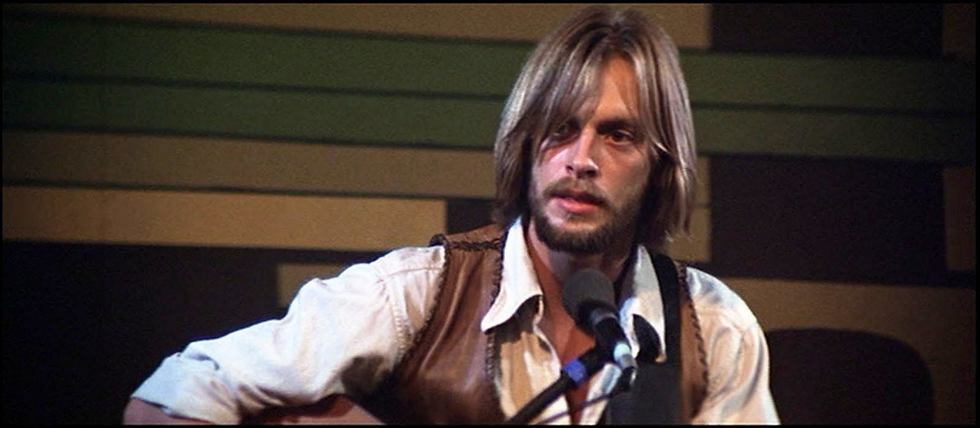
A later scene features folk singer Tom Frank (Keith Carradine) performing a love song in a nightclub. The song, “I’m Easy”, is about the singer’s difficulty hiding the sincerity of his love for an unnamed woman. It features lines like, I never cared too much for games/ and this one’s driving me insane. While he sings, he stares intently at somebody in the room, but exactly who is left unclear, as he’s had relationships with several women in the audience. Just as Haven Hamilton glorifies the American Dream with his music while struggling with the realities of American life, Tom portrays himself as a devoted, single-minded romantic, while he behaves like a semi-sociopathic misogynist off-stage. The music is powerful though, and Nashville doesn’t deny that; “I’m Easy” is such a genuinely beautiful song that, as a viewer, you wonder for a moment whether he might actually mean the words he’s singing in some strange way.

Ronee Blakely gives a wonderful performance as Barbara Jean, a charming classic country sweetheart a la Dolly Parton, in the midst of a series of mental and physical breakdowns. During the movie’s climactic scene, she sings a song called “My Idaho Home”, which reminisces on her idyllic upbringing, which starkly contrasts the chaotic, tenuous state of her health. But, as she sings, her words are so convincing that you almost think everything will be okay. This is part of what I love so much about Nashville– it exposes the artifice of performance but still works hard to convey the beauty of music, even when the accuracy of the songwriters is called into question.
There is so much more to say here, but I don’t want to spoil anything, as I really want you all to see this movie for yourselves! Please. I need somebody to talk about this with.


Comments